Skip to content
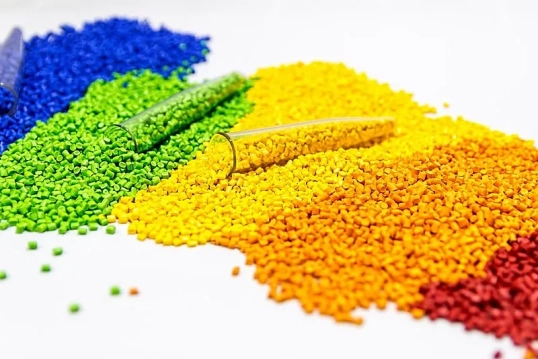
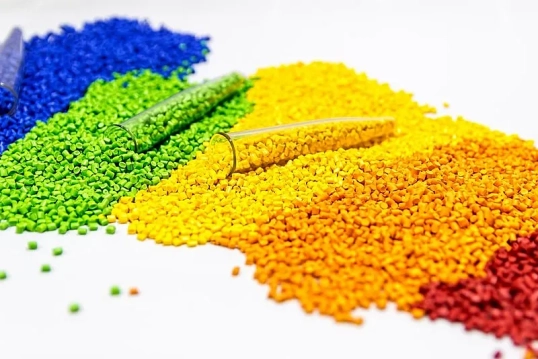
Red is easy to specify on a purchase order. Keeping it the same red after a concrete block cures, a primer dries, or a plastic profile leaves the die is harder. Industrial coloring is a process-control job. The colorant must wet out, cope with production, and behave the same way in the next batch. A line manager cannot correct every load by eye. That is why red iron oxide pigment is used so widely. It is an opaque mineral colorant chosen when durability and repeatability matter more than a fluorescent shade.
What Does Red Iron Oxide Bring to an Industrial Formula?
Most synthetic red oxide used for coloring is based on alpha-Fe2O3. The chemistry is useful because the pigment particles do not dissolve in cement, paint binder, or plastic resin. They remain as tiny solid particles distributed through the material. That helps explain the pigment's good hiding power and its low tendency to bleed or migrate.
The label on the bag, though, is only the starting point. Two red oxides can differ in particle size, undertone, tinting strength, oil absorption, moisture, and residue. Those differences reach the factory floor. One grade may need less pigment; another may need longer milling. A third may feed more smoothly through a dosing screw. Same chemistry, different production result.
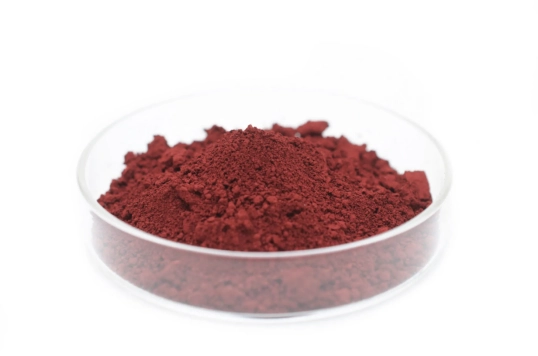
Concrete: Small Process Changes Can Be Seen in the Finished Block
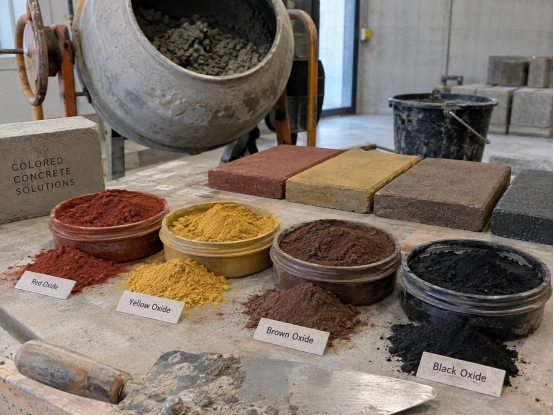
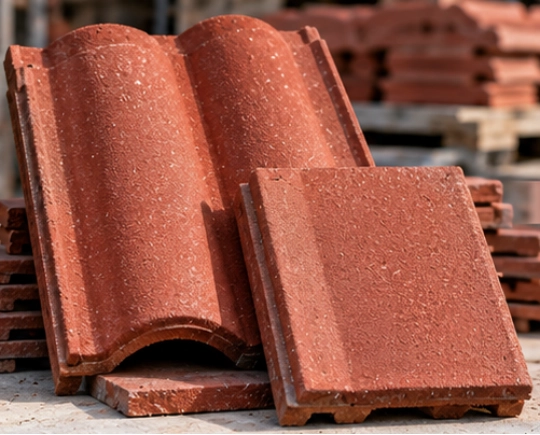
Fresh cement is a difficult environment for many colorants. It is strongly alkaline, the mix contains abrasive aggregate, and the finished piece may spend years in sun and rain. Red iron oxide is used in pavers, roof tiles, concrete bricks, mortar, and precast units because it can be mixed through the body of the product. A chipped corner does not immediately expose an uncolored layer underneath.
Pigment dosage is often trialed around 1% to 5% of cement weight. That is a beginning, not a recipe. Grey cement pulls the shade darker. White cement gives a cleaner red. Extra water can make the formula lighter, while a change in aggregate may shift it again. Even mixing time matters. Check those records before blaming the pigment batch.
Powder or Granules? Look at the Dosing Room
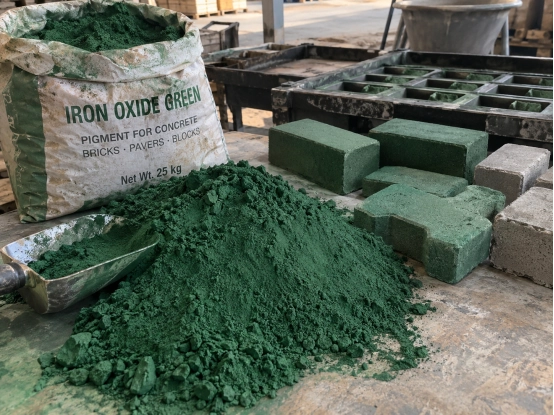
For hand weighing or short production runs, powder is usually straightforward and economical. Automated plants have a different problem: dust and repeatable feeding. Iron oxide red granules are made for that setting. They move through dosing equipment more cleanly and create far less airborne pigment during transfer. The granule must still break down in the mixer, of course. A plant trial should confirm both feeding accuracy and final color before the handling benefit is counted.
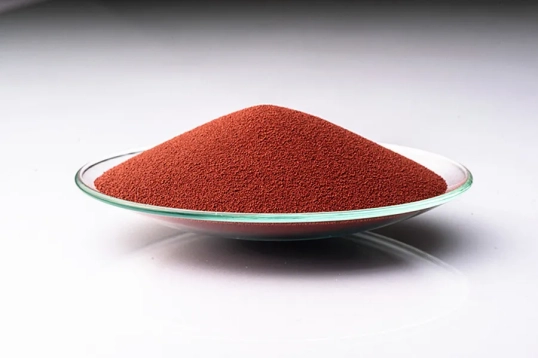
Coatings: The Film Quickly Exposes Poor Dispersion
A paint can contain the right pigment and still produce the wrong result. If the particles have not been wetted and separated properly, the dry film may show seeds, streaks, uneven gloss, or weak color. Adding more pigment rarely fixes the real problem. Sometimes it makes viscosity and milling time worse.
For a coating or primer, test the pigment in the actual binder. Water-based acrylic and solvent-based alkyd formulas do not treat every surface alike. Oil absorption changes binder demand; particle size and residue affect smoothness. The dispersant and milling equipment matter too. A substitute resin can make a tidy drawdown that says little about production.
Plastics: Heat Is Important, but It Is Not the Only Check
Iron oxide pigment does not melt into a polymer. It has to be distributed through it, either by dry blending, compounding, or a masterbatch. Poor distribution leaves streaks or dark concentrated spots that become obvious after extrusion or molding. Fine powder is not automatically well dispersed; feeding and shear have a say too.
Give the supplier the polymer and the real temperature window. Residence time, carrier resin, moisture, and surface finish also help. A grade that works in a PVC profile may not run the same way in every PE or PP part. Try it under normal line settings, then check shade and specks after the material cools.
A Shade Card Is Not a Complete Purchase Specification
"Red oxide, standard grade" leaves too much room for interpretation. A better request includes the substrate, a retained color sample or RAL reference, the process, the expected exposure, and any market documents needed. Coating buyers should name the binder and gloss range. Concrete producers should mention cement color and whether dosing is manual or automatic. Plastics processors should include polymer and processing temperature.
It also makes price comparisons more honest. A cheap bag may need more pigment or another milling pass. Cost per kilogram is easy to compare; cost for an approved shade is what matters.
How We Work at XT Pigment
At XT Pigment, we do not select a product from the color name alone. We first ask what is being colored and how the customer makes it. Our industrial iron oxide pigments include powder and granular options for construction materials, coatings, plastics, rubber, and related applications, but the useful recommendation comes from the process details.
We have worked with iron oxide pigments since 1999 and operate our own production and laboratory facilities. We check tinting strength, particle size, dispersibility, and color consistency. The customer's line gives the final answer.
For a new project, we review the target, suggest a starting grade, and provide a sample. It should be tried with the customer's normal raw materials and equipment. If the shade misses, we work back through dosage, dispersion, or grade selection. Packaging, batch documents, and delivery come after approval.
Conclusion
Red iron oxide gives formulators a stable, opaque colorant for demanding environments. Chemistry is only half the decision. Particle behavior, dosage, handling, and dispersion still have to fit the process. That is where a careful trial earns its keep.
Frequently Asked Questions
Q:Will Red Iron Oxide Pigment Affect Concrete Strength?
A:At normal coloring dosages, iron oxide is treated as an inert pigment and should not interfere with cement hydration. Still, check the finished mix against the producer's strength requirement.
Q:Why Did My Approved Red Shade Change in Production?
A:Start with what changed on the line: cement, aggregate, water, mixing, curing, or dosage. Compare the production record with the approved trial. If it matches, compare the retained pigment and batch report.
Q:Is Powder or Granular Iron Oxide Better for My Plant?
A:Neither form wins everywhere. Powder suits manual weighing and smaller runs. Granules suit automatic dosing and dust control. Test the form with the actual feeder and mixer before deciding.