Skip to content


When assessing an iron oxide red pigment such as a grade sold as Red 110, consider it for red coloration in selected coatings, plastics, and construction-material formulations. Its suitability depends on the exact grade and the formulation: the name alone does not confirm shade, opacity, transparency, dispersion, processing stability, or compliance. Confirm the supplier’s technical data and test the pigment in the intended binder or substrate before specifying it.

What Does the Iron Oxide Red 110 Designation Tell You?
“Iron Oxide Red 110” is a useful search and purchasing phrase, but it is not a complete specification. Buyers should confirm whether “110” refers to a color index designation, the supplier’s grade number, or a commercial name. Similar-looking labels can refer to products with different composition, undertone, particle characteristics, and intended applications.
Before comparing offers, request the full product name and applicable Color Index reference, together with a current technical data sheet (TDS) and safety data sheet (SDS). Check the stated color coordinates or shade description, physical form, recommended incorporation method, and any application-specific test information. A product’s “red iron oxide” description does not, by itself, establish a particular level of opacity, transparency, heat resistance, or weathering performance.
This distinction matters when matching the pigment to an existing formula. A red that appears close in a powder sample may shift in a clear coating, a highly filled cement mix, or a colored plastic. Verify the actual grade first, then judge its performance in the system where it will be used.
Which Construction Materials Can Use Iron Oxide Red 110?
Construction-material producers may evaluate a compatible red iron oxide grade in cement-based products, masonry finishes, and other building materials where a stable red shade is required. The desired result may be a through-color effect in a cementitious product or a surface color in a coating. In both cases, the grade must disperse evenly and suit the product’s binder, substrate, manufacturing process, and exposure conditions.
| Construction application | What the pigment may contribute | What to check in a trial |
| Cementitious products | Red or earthy coloration through the mix | Compatibility with the cement system, dispersion, shade consistency, and dosage guidance for the exact grade |
| Concrete or masonry coatings | A red finish on a mineral substrate | Binder compatibility, hiding or transparency target, adhesion system, and outdoor exposure requirements |
| Paving or precast products | Visual differentiation between product colors | Batch-to-batch shade control, mixing sequence, moisture, and curing conditions |
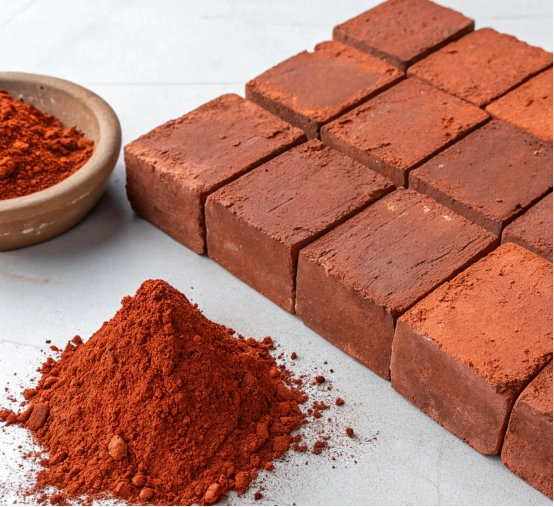
Treat these as application candidates rather than automatic approvals. A dosage that works in one cement, aggregate, or mixing process may not reproduce the same shade elsewhere. Start with the supplier’s recommendation, keep the raw materials and process controlled, and compare cured samples under consistent lighting. If you are formulating cement products, set the iron oxide pigment dosage through controlled trials with your cement, aggregate, and curing conditions; validate the exact grade separately. For construction materials, test color and dispersion in the actual mix or coating before setting a production target.
Where Can Iron Oxide Red 110 Fit in Coatings and Plastics?
In coatings, a red iron oxide grade may be evaluated for architectural, industrial, or other protective and decorative finishes when its shade and optical effect suit the design. The formulator should check compatibility with the resin and solvent or waterborne system, pigment wetting and dispersion, target hiding power, film build, and intended indoor or outdoor exposure. Color stability should be established for the complete coating, not inferred from the pigment name.
For plastics, the key questions change with the polymer and process. Confirm that the grade disperses in the chosen resin and remains suitable at the actual processing temperature and residence time. Also assess the finished part’s shade, surface appearance, and end-use exposure. A pigment that performs acceptably in a room-temperature coating may not be the right choice for a melt-processed polymer.
When you evaluate a grade for coating and paint formulations, we recommend requesting application-relevant data and running a controlled trial. Compare equal pigment additions in the same binder or resin, using the same mixing conditions and sample thickness. This shows whether the grade reaches your target shade and disperses adequately in your process. Do not transfer a result from paint to plastic, or from one resin to another, without testing.
How Should You Qualify an Iron Oxide Red 110 Grade?
Use a short qualification sequence before adopting a grade in production:
- Confirm identity. Match the supplier’s complete designation and Color Index reference to your specification. Review the TDS and SDS, plus any regulatory declarations required for your market and end use.
- Set the optical target. State the required shade, undertone, hiding power, or transparency. Make drawdowns or molded samples in the actual binder or resin; a powder comparison alone is not enough.
- Check dispersion and processing. Follow the supplier’s incorporation guidance, then inspect for agglomerates, streaks, or uneven color. For plastics, test at the intended process conditions; for cementitious products, keep mixing and curing conditions consistent.
- Verify end-use performance. Select relevant checks for the product, such as weathering, water exposure, heat, or other service conditions. Use agreed test methods and acceptance limits rather than relying on a general “durable” claim.
For example, compare two candidate grades at the same addition level in the same resin, using the same dispersion procedure and film thickness. Record the resulting color and hiding or transparency, then inspect for visible dispersion defects. This is a controlled screening comparison, not a universal dosage recommendation: a later adjustment may be needed to reach the commercial target, and the result applies only to the tested system.
FAQ
Here are concise answers to common formulation and purchasing questions about this pigment designation.
Is Iron Oxide Red 110 the Same As Every Red Iron Oxide Grade?
No. “Red 110” may identify a specific color index or supplier grade, and products can differ in shade and behavior. Confirm the full designation and grade data before comparing or substituting products.
Can Iron Oxide Red 110 Be Used in Concrete?
It may be evaluated in a compatible cementitious formulation. Check alkali compatibility, dispersion, target shade, and the supplier’s dosage guidance for that exact grade, then compare cured samples under controlled conditions.
Is Red 110 Suitable for Both Paint and Plastic?
Potentially, but each system needs a separate assessment. Coatings and plastics differ in binders, dispersion methods, processing conditions, and end-use requirements, so validate the pigment in each intended formulation.
How Do You Choose Between Transparent and Opaque Red Pigments?
Match the optical effect to the product. Transparency may matter in a translucent layer, while hiding power may be more important on an opaque substrate. Confirm the result with a drawdown or molded sample in the intended system.
What Should a Buyer Include in a Red 110 Sample Request?
Include the application, binder or substrate, process conditions, target shade and opacity, end-use exposure, required documents or regulatory declarations, and the sample quantity needed for evaluation.
What Should You Send with an Iron Oxide Red 110 Inquiry?
When you send us your target application and specification, include the intended product, binder or substrate, processing conditions, color and opacity target, and required service or compliance conditions. Ask us to confirm the exact grade identity, available technical documents, application guidance, and sample options. That gives us a clear basis for deciding whether a laboratory or production trial is appropriate.